

When I first looked into how fake insurance claims are identified, I assumed most of the work depended on manual investigation. An adjuster would review documents, compare details, and try to spot inconsistencies. That approach still exists, but it is no longer the first line of defense. Today, AI in detecting fake insurance claims is doing the heavy lifting by analyzing data in real time and flagging suspicious patterns before a claim moves forward.
AI in detecting fake insurance claims uses machine learning, anomaly detection, and behavioral analysis to identify fraud signals instantly. Instead of relying only on manual checks, insurers now use data-driven systems that evaluate every claim against thousands of risk indicators within seconds.
How AI in Detecting Fake Insurance Claims Works Behind the Scenes
What changed with AI is not just speed, but the depth of analysis. Traditional fraud detection depends on rules such as checking duplicate claims or verifying documents. AI systems go beyond that by learning patterns from past fraud cases and applying that learning to new claims.
When a claim is submitted, the system evaluates multiple factors at once. It looks at the claim amount, timing, location, past claim history, and even how the information is entered. These signals are compared with known fraud patterns, and if something does not align, the system assigns a risk score.
Read also: AI vs Human Fraud Detection in Credit Cards
From what I’ve seen, this process happens almost instantly. The system does not wait for human review to begin. It highlights high-risk claims immediately so that investigators can focus on the cases that actually need attention.
Pattern Recognition and Anomaly Detection in Insurance Fraud
One of the most effective techniques AI uses is pattern recognition. Every legitimate claim tends to follow certain patterns based on real-world events. Fraudulent claims often break these patterns, even if the difference is small. AI models are trained to detect these subtle deviations.
For example, if a claim is filed unusually quickly after a policy is purchased, or if multiple claims share similar details across different accounts, the system flags these as anomalies. This type of anomaly detection in insurance fraud is difficult to perform manually because it requires comparing large volumes of data across multiple cases.
AI makes this possible by analyzing patterns continuously and refining its detection methods over time.

Real-Time Data Analysis That Speeds Up Fraud Detection
Another reason AI detects fake insurance claims instantly is its ability to process data in real time.
As soon as a claim enters the system, AI evaluates it alongside historical data, external databases, and behavioral signals. This allows insurers to take action before the claim is approved or paid out.
From my perspective, this is one of the biggest advantages. Fraud detection is no longer reactive. It becomes proactive, which reduces losses and improves efficiency.
This is why real-time fraud detection systems are becoming a standard part of modern insurance platforms.
Behavioral Analysis and Claim Consistency Checks
AI does not only analyze data points individually. It also studies behavior. For example, it can evaluate how a claimant interacts with the system, the consistency of their information, and whether their behavior aligns with typical claim patterns. If there are inconsistencies, such as conflicting details or unusual activity, the system flags them for review.
This behavioral analysis adds another layer of detection that goes beyond traditional document checks. It helps identify fraud even when the claim appears valid on the surface.
Image and Document Verification Using AI in Insurance Claims
In many cases, insurance claims include images, invoices, or supporting documents. AI systems can analyze these as well.
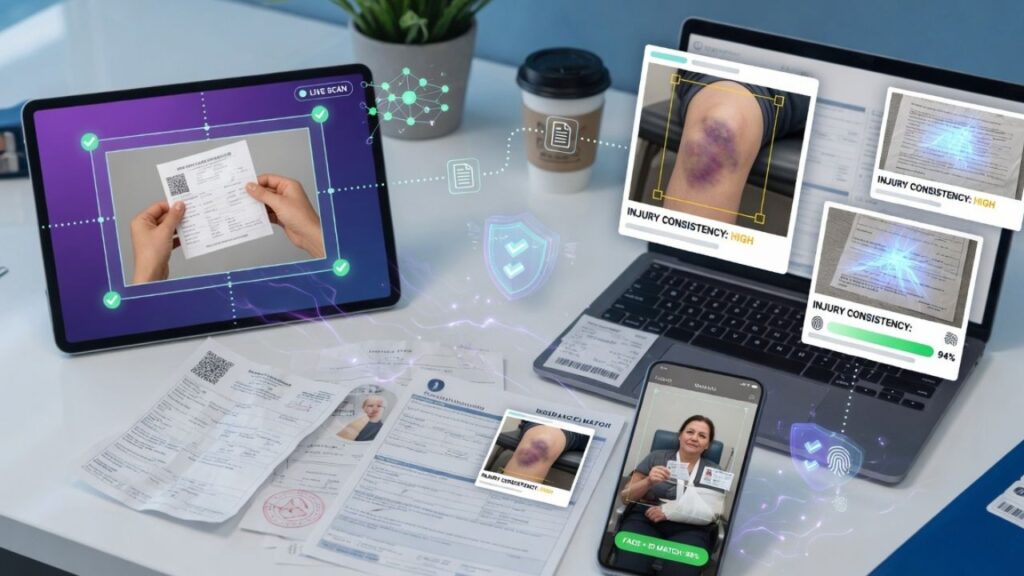
For example, image recognition tools can detect whether a photo has been reused, edited, or taken from another source. Document analysis tools can identify inconsistencies in invoices or detect signs of manipulation.
From what I’ve observed, this reduces the chances of fraud slipping through based on falsified evidence. It also speeds up verification because the system can process documents much faster than manual review.
Risk Scoring and Prioritization of Suspicious Claims
AI does not treat every claim the same. It assigns a risk score based on the likelihood of fraud. Low-risk claims move through the system quickly, while high-risk claims are flagged for deeper investigation. This prioritization allows insurers to focus resources where they are needed most.
Instead of reviewing every claim manually, teams can concentrate on cases that show strong fraud signals. This improves both efficiency and accuracy in fraud detection.
How AI Reduces False Positives in Fraud Detection
One challenge in fraud detection is avoiding false positives, where legitimate claims are flagged incorrectly.
AI helps reduce this by learning from past decisions. When investigators confirm whether a claim is fraudulent or genuine, the system updates its models accordingly. Over time, this improves accuracy and reduces unnecessary disruptions for customers.
From my experience, this continuous learning is what makes AI systems more reliable compared to static rule-based approaches.

Why Human Investigators Still Matter in AI Fraud Detection
Even though AI detects fake insurance claims instantly, human expertise remains important. AI identifies patterns and flags risks, but investigators review complex cases and make final decisions. They consider context, verify details, and ensure that genuine claims are not rejected.
The combination of AI and human judgment creates a balanced system where speed and accuracy work together.
What This Means for Insurers and Policyholders
For insurers, AI reduces fraud losses, speeds up claim processing, and improves operational efficiency. For policyholders, it means faster approvals for genuine claims and fewer delays caused by manual checks.
From what I’ve seen, this creates a better experience on both sides. Fraud detection becomes more precise without slowing down legitimate claims.
A Smarter Approach to Insurance Fraud Prevention
The biggest shift I’ve noticed is that fraud detection is no longer about catching fraud after it happens. It is about preventing it before it causes damage.
AI in detecting fake insurance claims allows insurers to act early, identify risks quickly, and maintain trust in the system. As these technologies continue to improve, fraud detection will become even more accurate and less intrusive for genuine users.
FAQs
AI analyzes multiple data points, patterns, and behaviors in real time, allowing it to identify suspicious activity within seconds.
AI cannot eliminate fraud entirely, but it significantly reduces it by detecting patterns early and supporting faster investigation.
No, insurers use AI for detection and human investigators for verification and final decisions.

Samuel Clarke
Samuel ClarkeSamuel Clarke is an insurance specialist with hands-on experience in policy management, risk assessment, and customer-focused financial protection strategies. He holds a Bachelor’s degree in Business Administration from the University of Florida, He has already built a strong foundation in the insurance industry, having previously worked as an Insurance Manager.