
When I first explored how car insurance quotes are calculated, the process felt rigid. You fill in your details, and the insurer gives you a price based on broad categories like age, location, and driving history. There was very little sense of personalization.
Now, AI in car insurance quotes pricing is changing that completely. Instead of relying only on static data, insurers use AI-powered pricing models to evaluate real driving behavior, risk patterns, and real-time data. This shift is making insurance pricing more dynamic, more accurate, and in many cases, more fair for drivers.
AI in car insurance quotes pricing uses machine learning, telematics data, and behavioral analysis to calculate premiums based on real-world driving patterns and risk factors. This helps insurers offer more personalized quotes, improve risk assessment, and adjust pricing more accurately than traditional methods.
How AI in Car Insurance Quotes Pricing Works in Modern Systems
Traditional car insurance pricing depends on fixed variables such as age, gender, vehicle type, and past claims. While these factors still matter, they do not always reflect how someone actually drives.
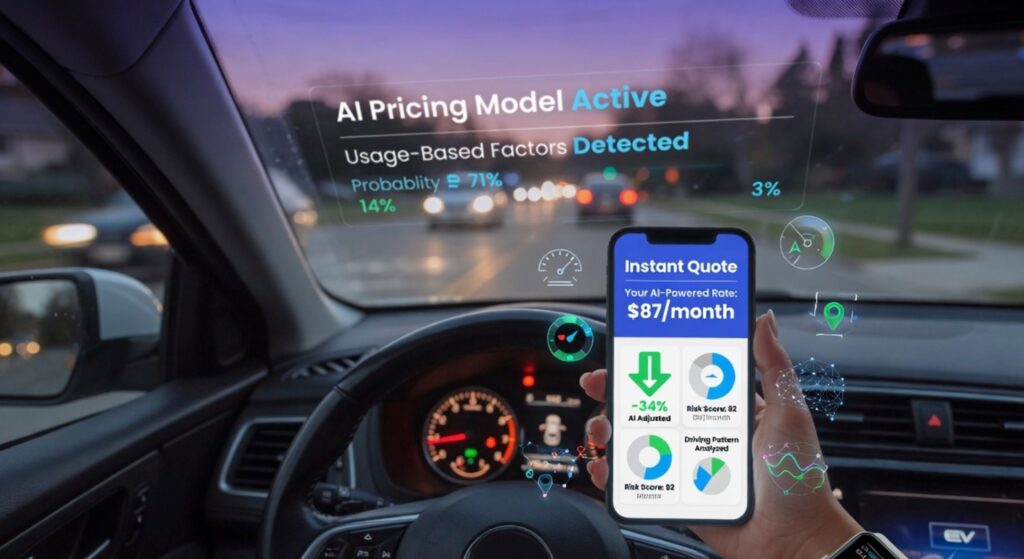
AI changes this by analyzing real-time and historical data together. Insurers use telematics devices or mobile apps to track driving behavior, including speed, braking patterns, distance, and time of travel. AI models then process this data to assess risk more precisely.
From what I’ve seen, this approach gives insurers a deeper understanding of individual drivers instead of grouping them into broad categories. That is why AI-powered car insurance pricing models are becoming more common across digital insurance platforms.
AI-Based Car Insurance Pricing vs Traditional Quote Systems
The difference between AI-driven pricing and traditional systems is not just technical. It directly affects how quotes are calculated.
Traditional systems apply generalized risk profiles. For example, younger drivers may receive higher premiums regardless of their actual driving habits. AI-based systems take a more detailed approach by evaluating behavior instead of assumptions.
This means safer drivers can benefit from lower premiums even if they fall into traditionally “high-risk” categories. At the same time, risky driving behavior may lead to higher pricing, regardless of age or background.
This shift is why usage-based insurance pricing and AI-driven premium calculation are becoming key trends in the industry.
Role of Telematics and Usage-Based Insurance in AI Pricing
One of the most important changes I noticed is the rise of telematics in car insurance.
Telematics devices or apps collect driving data continuously. AI then analyzes this data to create a risk profile based on actual behavior. This model is often called usage-based insurance (UBI).
For example, AI can evaluate:
- How often you drive at night
- How smoothly you brake and accelerate
- How consistently you follow speed limits
This data-driven approach makes AI car insurance quote pricing more personalized and performance-based rather than assumption-based.
How AI Improves Accuracy in Car Insurance Premium Calculation
Accuracy is where AI creates a clear advantage.
Traditional models rely on limited data points, which can lead to overpricing or underpricing. AI systems analyze multiple variables simultaneously, allowing insurers to calculate car insurance premiums with greater precision.
From my perspective, this reduces the gap between perceived risk and actual risk. Drivers who maintain safe habits are more likely to receive fair pricing, while insurers can manage risk more effectively.
This is why AI-based insurance underwriting is becoming a core part of modern insurance systems.
Faster Car Insurance Quotes with AI Automation
Another noticeable improvement is speed.
AI-powered systems can process large amounts of data instantly, allowing insurers to generate quotes much faster than traditional methods. Instead of waiting for manual evaluation, customers can receive real-time pricing.
For users, this means quicker access to online car insurance quotes with AI pricing, which improves overall experience and decision-making.
Fraud Detection and Risk Prevention Using AI
AI does not only focus on pricing. It also helps insurers detect fraud and reduce risk.
By analyzing patterns in claims and customer behavior, AI systems can identify unusual activity that may indicate fraudulent claims. This strengthens the reliability of the pricing model because it is based on cleaner, more accurate data.
From what I’ve observed, this improves trust in the system while helping insurers maintain stable pricing structures.
Read also: 5 AI Tools Insurance Companies Use to Detect Fraud
Real Impact: More Personalized and Fair Insurance Pricing
The biggest shift I’ve seen is personalization.
AI in car insurance quotes pricing moves away from generalized assumptions and toward individual behavior. This makes pricing feel more transparent and aligned with how people actually drive.
Drivers who maintain safe habits benefit from lower premiums, while insurers gain better control over risk. This balance creates a more efficient system for both sides.
Limitations of AI in Car Insurance Pricing
Even though AI improves the system, it is not without limitations.
Data privacy is one concern, as telematics requires access to driving behavior. Some users may not feel comfortable sharing this level of data. Additionally, AI models depend on data quality, so incomplete or inaccurate data can affect results.
Another limitation is that not all insurers have fully adopted advanced AI systems yet, which means experiences can vary across providers.
My Final Thoughts
AI in car insurance quotes pricing is not just improving calculations. It is changing how pricing is structured altogether.
Instead of relying on broad assumptions, insurers are now focusing on real behavior, real data, and real risk patterns. This creates a system that is more accurate, faster, and more aligned with individual drivers.
From what I’ve seen, this shift will continue to grow as more insurers adopt AI-driven pricing models. For drivers, this means better opportunities to receive fair and personalized insurance quotes based on how they actually drive.
FAQs
AI can make car insurance cheaper for safe drivers because pricing is based on actual driving behavior rather than general assumptions. However, risky driving patterns may lead to higher premiums.
Usage-based insurance uses AI and telematics data to calculate premiums based on how, when, and how much you drive. It focuses on real behavior instead of fixed categories.
AI pricing is generally more accurate because it analyzes multiple data points and real driving behavior. However, accuracy depends on the quality of the data collected.

Samuel Clarke
Samuel ClarkeSamuel Clarke is an insurance specialist with hands-on experience in policy management, risk assessment, and customer-focused financial protection strategies. He holds a Bachelor’s degree in Business Administration from the University of Florida, He has already built a strong foundation in the insurance industry, having previously worked as an Insurance Manager.