
When I first started investing in the US stock market with AI, I assumed it would be complicated. I thought I would need deep technical knowledge or advanced tools to make it work. But once I explored it properly, I realized something important.
AI does not replace your decision-making. It improves how you analyze information and reduces the time you spend figuring out what to do next. If you use it correctly, it becomes a practical assistant that helps you invest with more clarity.
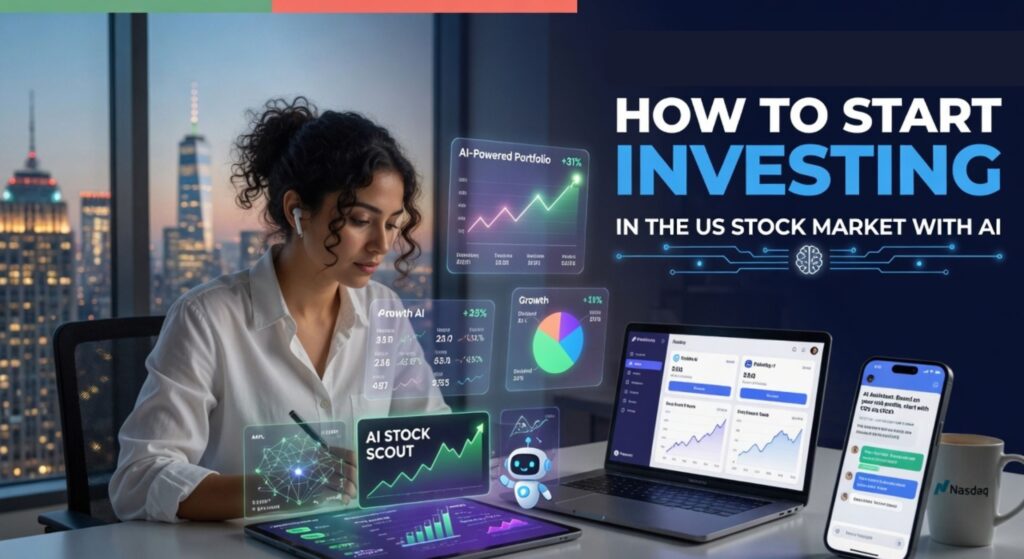
Investing in the US stock market with AI means using AI-powered investing tools, stock analysis platforms, and data-driven insights to identify opportunities, manage risk, and build a portfolio more efficiently. These tools help beginners and experienced investors make better decisions without relying only on manual research.
Why Investing in the US Stock Market with AI Is Growing Fast
The US stock market offers access to global companies, strong liquidity, and consistent opportunities. What has changed recently is how investors approach it.
AI stock investing tools now allow you to analyze market trends, company data, and financial signals in a way that was not possible earlier. Instead of spending hours reading reports, you can quickly understand what matters and focus on decisions.
From my experience, the biggest advantage is not automation. It is clarity. You see patterns faster, and that changes how you approach investing.
How to Start Investing in the US Stock Market with AI Step by Step
Starting does not require complex setups, but it does require a clear approach.
First, you need a reliable brokerage account that allows access to US stocks. Platforms like Robinhood, Interactive Brokers, or eToro make this accessible even for beginners.
Once your account is set up, the next step is to use AI-powered investing tools. These tools help you analyze stocks, understand trends, and evaluate risk without doing everything manually.
What I found useful early on was not trying to use too many tools at once. Starting with one or two platforms keeps things simple and manageable.
Using AI Tools for Stock Market Analysis and Investment Decisions
AI tools for stock market investing focus on analyzing data and providing insights. They look at price trends, financial metrics, and market signals to help you understand where opportunities may exist.
Instead of guessing, you rely on structured data.
For example, AI stock analysis platforms can:
- Identify strong or weak trends
- Highlight potential entry points
- Evaluate company performance
- Compare multiple stocks quickly
From experience, these insights are most useful when you treat them as guidance, not final decisions. You still need to understand why a stock looks attractive.
Building a Portfolio with AI-Based Investment Strategies
Once you start investing, the next step is building a balanced portfolio. AI portfolio management tools help you allocate funds across different stocks and sectors based on your risk level.
This is where AI investing becomes practical.
Instead of putting money randomly into trending stocks, you create a structured portfolio. AI helps you understand diversification, which reduces risk and improves long-term stability.
For beginners, this approach makes investing less overwhelming because you are not trying to figure everything out manually.
Read also: How Hedge Funds Use AI for Stock Market Profits in 2026
Risk Management in AI Stock Market Investing
One of the biggest mistakes new investors make is ignoring risk.
AI tools help by tracking volatility, analyzing downside risk, and suggesting adjustments based on market conditions. This does not eliminate risk, but it makes it easier to manage.
From what I’ve seen, investors who use AI for risk analysis tend to make more balanced decisions because they are not reacting emotionally to market changes.
Common Mistakes When Using AI for Investing in US Stocks
Even though AI tools are powerful, using them incorrectly can lead to poor results.
One mistake I often notice is relying completely on AI signals without understanding the reasoning behind them. Another issue is chasing short-term trends instead of focusing on long-term growth.
AI works best when you combine it with basic investing principles. You still need to think about fundamentals, market conditions, and your own financial goals.
How Much Money Do You Need to Start AI Investing?
You do not need a large amount to begin.
Many platforms allow fractional investing, which means you can start with a small amount and still invest in major US stocks. What matters more is consistency and learning how the system works.
From my experience, starting small and building gradually gives you a better understanding than jumping in with a large amount without clarity.
Read also: 5 Best AI Tools for Stock Trading in 2026
Real Insight: AI Makes Investing Easier, Not Effortless
This is something I understood over time.
AI reduces effort, but it does not remove responsibility. You still need to review your decisions, understand your portfolio, and stay aware of market changes.
The advantage is that AI handles the heavy analysis, so you can focus on making better decisions instead of getting lost in data.
Final Thoughts on Investing in the US Stock Market with AI
AI is changing how people invest, but it is not creating shortcuts to guaranteed profits. It is improving how decisions are made by giving better data, faster insights, and clearer direction.
From my perspective, the best way to approach AI investing is to treat it as a support system. When you combine AI tools with your own understanding, you build a process that is both efficient and reliable.
If you stay consistent, keep learning, and use AI thoughtfully, investing in the US stock market becomes much more approachable than it seems at first.
FAQs
AI investing is safe when used properly because it provides data-driven insights and reduces guesswork. However, you still need to understand basic investing principles and avoid relying entirely on automated signals.
AI does not predict the market with certainty. It analyzes patterns and probabilities based on data, which helps improve decision-making but does not guarantee results.
There is no single best tool, but beginner-friendly platforms that combine stock analysis and simple dashboards work well. The key is choosing a tool that helps you understand data clearly rather than overwhelming you.

Matthew Gibson
Matthew Gibson — Stock Market & Trading ExpertMatthew Gibson is a stock market analyst, active trader, and entrepreneur with extensive experience in equity markets, technical analysis, and portfolio management. He holds a Bachelor’s degree in Finance from the University of California, Berkeley and an MBA in Investment Management from the Columbia Business School.