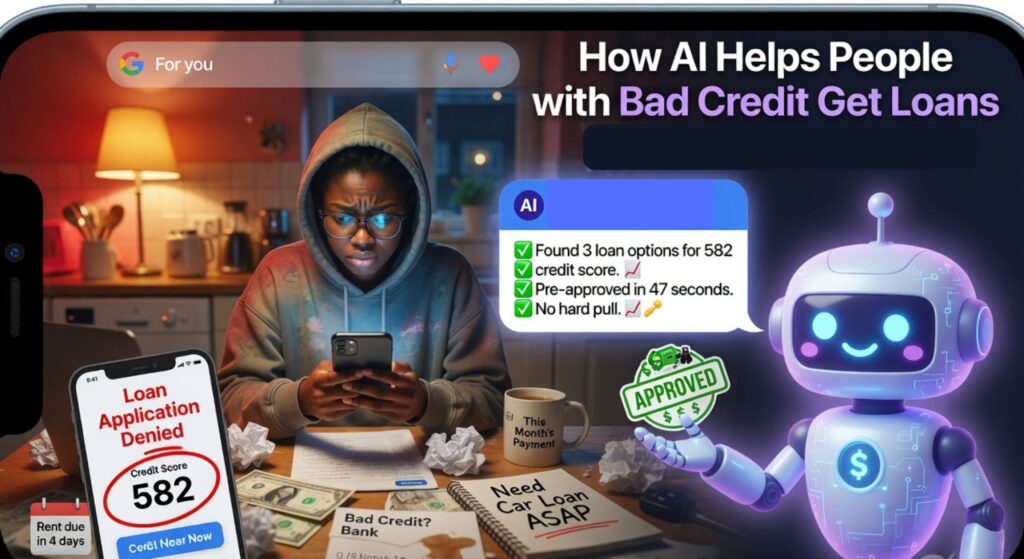

When I first looked into how people with low credit scores get approved for loans today, I realized something has changed quietly but significantly. Earlier, a bad credit score often meant an automatic rejection. Banks relied heavily on fixed credit scoring models, and there was very little room for flexibility.
Now, AI in loan approval for bad credit is changing that process. Instead of judging applicants based only on a single number, lenders are using AI-driven credit assessment systems to understand the full financial picture. This shift is making it possible for more people to qualify for loans, even if their traditional credit score is not strong.
AI in loan approval for bad credit uses machine learning and alternative data to evaluate borrowers beyond traditional credit scores. It helps lenders assess risk more accurately, offer fairer decisions, and approve loans for individuals who may have been rejected under older systems.
How AI in Loan Approval for Bad Credit Works in Real Lending Systems
Traditional loan approval systems focus heavily on credit scores, repayment history, and fixed eligibility criteria. While this approach is structured, it often overlooks important financial behaviors that indicate whether someone can actually repay a loan.
AI changes this by analyzing a wider range of data points. These include transaction patterns, income consistency, spending behavior, and even digital financial activity. Instead of looking at isolated factors, AI models connect these signals to understand how a borrower manages money over time.
From what I’ve seen, this approach allows lenders to identify responsible borrowers who may not have a strong credit history but still demonstrate reliable financial behavior. This is where AI-powered loan approval systems create opportunities that traditional systems would miss.
Why Traditional Credit Scoring Fails Many Borrowers
Before understanding how AI helps, it’s important to see where the old system falls short.
Traditional credit scoring models rely on past borrowing behavior. If someone has limited credit history or past financial issues, their score reflects that, even if their current situation has improved. This creates a gap where people who are financially stable today are still judged by outdated data.
AI in bad credit loan approval reduces this limitation by focusing on present financial activity instead of only historical records. This makes the evaluation more dynamic and relevant to current conditions.
Read also: AI vs Traditional Loan Approval: Which Is Better in 2026
Alternative Data and AI-Based Credit Risk Assessment
One of the biggest changes I noticed is the use of alternative data in AI credit risk assessment.
Instead of relying only on credit reports, AI systems analyze:
- Bank transaction history
- Income patterns and stability
- Utility payments and recurring expenses
- Digital financial behavior
This gives lenders a more complete understanding of a borrower’s financial habits. For someone with bad credit, this can make a significant difference because it highlights positive behavior that traditional scoring systems ignore.
This is why terms like AI credit scoring for bad credit, alternative data lending, and AI risk assessment in lending are becoming more common in modern fintech platforms.
Faster Loan Approval with AI for Bad Credit Borrowers
Another major advantage is speed.
In traditional systems, applications go through multiple verification steps, which can delay decisions. With AI-based loan approval, much of the data analysis happens instantly. This allows lenders to process applications faster and provide decisions in a shorter time.
For borrowers, this means access to fast personal loan approval for bad credit and online loan approval without lengthy delays.
However, speed does not mean less scrutiny. It simply means the evaluation process is more efficient.
AI Reduces Bias and Improves Fair Lending
From what I’ve observed, AI also helps reduce certain types of bias in loan decisions.
Traditional systems may unintentionally favor specific profiles based on rigid criteria. AI models, when properly designed, focus on data patterns rather than subjective judgment. This can lead to more balanced decisions, especially for applicants who do not fit standard profiles.
That said, the effectiveness depends on how well the AI system is trained. Poor data can still lead to biased outcomes, which is why oversight remains important.
Risk Management: Why Lenders Trust AI for Bad Credit Loans
You might wonder why lenders are willing to approve loans for borrowers with lower credit scores.
The answer lies in risk management.
AI systems do not simply approve more loans. They improve how risk is calculated. By analyzing multiple data layers, lenders can identify which borrowers are likely to repay despite having a low credit score.
This improves confidence in offering bad credit personal loans while maintaining control over default risks.
Real Benefit for Borrowers with Low Credit Scores
From a borrower’s perspective, the biggest advantage is opportunity.
AI in loan approval for bad credit creates access where there was none before. It allows individuals to demonstrate financial responsibility through real behavior instead of being judged solely by past records.
This does not mean everyone will be approved, but it does mean more people get a fair evaluation.
Some Limitations You Should Understand
Even though AI improves the system, it is not a complete solution.
Approval still depends on:
- Financial stability
- Income consistency
- Overall risk profile
AI expands eligibility, but it does not eliminate risk-based decisions. It also depends heavily on data accuracy, which means incomplete or incorrect data can still affect outcomes.
My Final Thoughts
AI in loan approval for bad credit is not just about technology. It is about changing how financial trust is measured.
Instead of relying only on past mistakes, lenders are starting to consider present behavior and future potential. This shift is making lending more flexible, more inclusive, and more aligned with real financial situations.
From what I’ve seen, this is one of the most practical ways AI is improving financial access, especially for people who were previously overlooked by traditional systems.

Kristin Winslow
Kristin WinslowKristin Winslow is a Loan & credit cards specialist with a strong background in consumer finance, focusing on rewards optimization, credit management, and responsible borrowing strategies. She holds a Bachelor’s degree in Finance from the University of Michigan and a certification in Financial Planning from the New York University.