
When I started digging into how lenders decide who is risky in the housing market, I realized something important. It is not just about whether someone can pay a loan today. It is about whether they are likely to keep paying consistently over years, even when market conditions change. That is where AI in home loan risk prediction in the USA housing market has started to reshape how lenders think.
Earlier, lenders relied heavily on credit scores, income proofs, and past repayment history. Those factors still matter, but they only tell part of the story. What AI does differently is connect multiple layers of financial behavior, market trends, and economic signals to estimate risk in a more realistic way.
AI in home loan risk prediction in the US housing market uses machine learning models, borrower behavior data, and housing market trends to assess the likelihood of default. Instead of relying only on static inputs, it evaluates how different factors interact over time.
How USA Lenders Traditionally Judged Mortgage Risk and Why It Fell Short
If you look at traditional mortgage underwriting, it follows a structured checklist. Credit score, debt-to-income ratio, employment stability, and savings history are reviewed carefully. While this creates a standardized process, it also limits how risk is understood.

From what I’ve seen, two borrowers with similar credit scores can behave very differently over time. One may manage finances carefully, while the other may struggle under changing conditions.
Traditional models often fail to capture that difference because they rely on fixed snapshots of financial data. This is where AI-driven mortgage risk assessment starts to offer a more flexible and accurate view.
How AI Predicts Home Loan Risk Using Real Financial Behavior in USA
AI does not just look at whether you qualify today. It looks at how you manage money over time. For example, AI models analyze spending consistency, savings patterns, income stability, and even how frequently your financial behavior changes. These signals help lenders understand how resilient a borrower is under financial pressure.
From my perspective, this is one of the most practical improvements. Instead of judging based only on past records, lenders can evaluate how likely someone is to handle future obligations.
This is why AI mortgage risk assessment models are becoming more important in modern lending systems.
The Role of USA Housing Market Trends in AI Risk Prediction
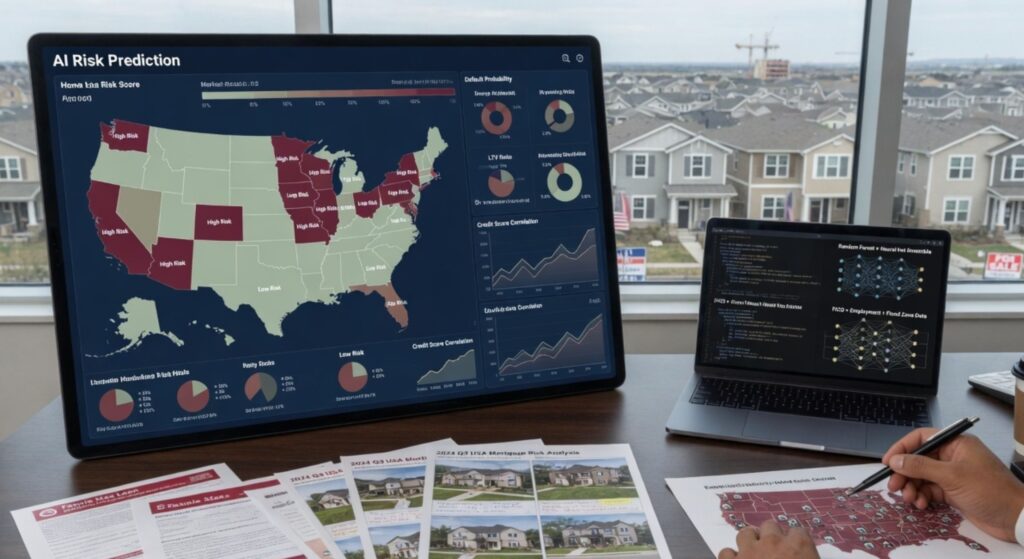
Home loan risk is not only about the borrower. It is also about the market. AI systems analyze housing market data such as property values, regional demand, interest rate trends, and economic conditions. These factors influence how risky a loan becomes over time.

For example, if property values in a certain area show signs of instability, the risk associated with loans in that region increases. AI models factor in these external conditions when calculating risk.
What I’ve noticed is that this creates a more complete picture. Risk is no longer seen in isolation. It is evaluated in the context of the broader housing market.
Predictive Models That Estimate Default Probability
One of the most important things AI does is estimate the probability of default. Instead of saying a borrower is either risky or safe, AI assigns a probability score based on multiple variables. This includes financial behavior, loan structure, and market conditions.
This probability-based approach changes how decisions are made. Lenders can adjust loan terms, interest rates, or approval conditions based on the level of risk rather than using a one-size-fits-all model.
From what I’ve seen, this leads to more balanced decisions where both risk and opportunity are considered.
How AI Speeds Up Mortgage Risk Evaluation Without Reducing Accuracy
Mortgage approvals used to take time because risk evaluation required manual review. AI speeds this up by analyzing data instantly and providing structured insights.
What stands out to me is that speed does not come at the cost of accuracy. In fact, it often improves it because AI evaluates more data points than a human could handle manually. This allows lenders to process applications faster while maintaining confidence in their decisions.
Why AI-Based Risk Models Are More Adaptive to Changing Conditions
The housing market does not stay constant. Interest rates change, economic conditions shift, and property values fluctuate.
Traditional models struggle to adapt quickly because they rely on predefined rules. AI models, on the other hand, update as new data becomes available.
From my experience, this adaptability is critical. A borrower who looks low-risk today could become high-risk under different conditions, and AI helps capture that shift earlier.
This is why predictive analytics in mortgage lending is becoming more valuable in the US housing market.
What This Means for Borrowers in Real Situations
For borrowers, this shift can work in both directions. If your financial behavior is stable and consistent, AI can improve your chances of approval even if your credit score is not perfect. At the same time, if your financial patterns show instability, the system will detect that quickly.

What I’ve observed is that the process becomes more transparent in terms of behavior. You are not judged only by a number. You are evaluated based on how you manage your finances over time.
How USA Lenders Balance AI Insights with Human Judgment
Even with advanced AI systems, lenders do not rely entirely on automation. Human underwriters still review complex cases, interpret edge situations, and ensure that decisions make sense in context. AI provides the analysis, but humans ensure the decision is practical.
From my perspective, this combination creates a more reliable system because it balances data-driven insights with real-world judgment.
A More Realistic Way to Understand Mortgage Risk Today
The biggest shift I’ve noticed is how risk itself is defined. Instead of being a fixed label based on past data, risk is now seen as something that evolves over time. AI captures that evolution by continuously analyzing both borrower behavior and market conditions.
AI in home loan risk prediction in the USA housing market is not just improving approval decisions. It is changing how lenders understand long-term financial stability.
FAQs
AI analyzes borrower behavior, financial data, and housing market trends to estimate the probability of loan default.
No, credit scores are still used, but AI adds more data layers to provide a more complete risk evaluation.
AI improves accuracy by analyzing multiple variables and adapting to changing market conditions.

Kristin Winslow
Kristin WinslowKristin Winslow is a Loan & credit cards specialist with a strong background in consumer finance, focusing on rewards optimization, credit management, and responsible borrowing strategies. She holds a Bachelor’s degree in Finance from the University of Michigan and a certification in Financial Planning from the New York University.