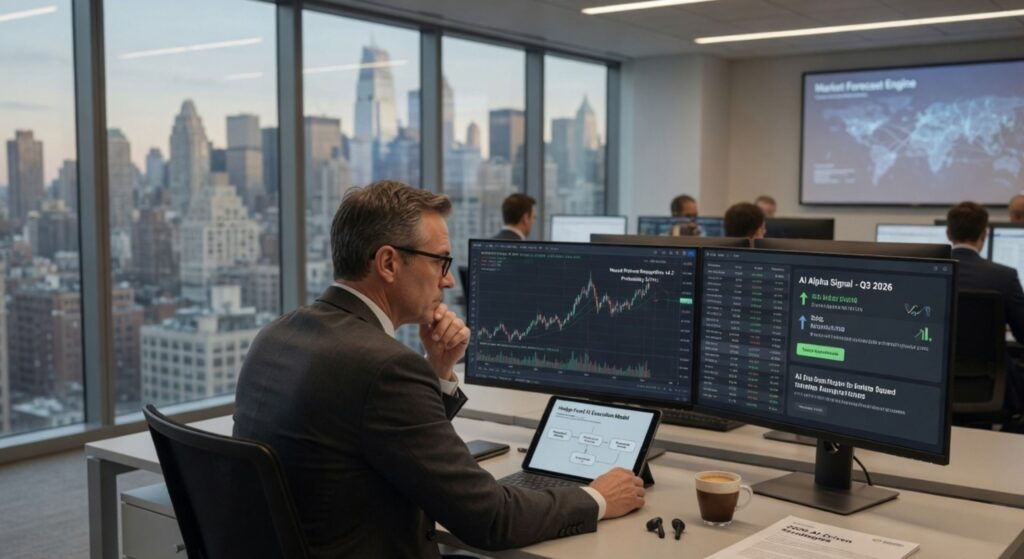

When I started digging into how hedge funds actually generate consistent returns, I realized something important. It is no longer just about having better analysts or faster news access. The real shift has happened in how data is processed and decisions are executed. Today, hedge funds are using AI in stock market trading to gain an advantage that is difficult to match manually, and that advantage comes from scale, speed, and structured decision-making.
AI in hedge fund trading refers to the use of machine learning models, algorithmic trading systems, and large-scale data analysis to identify opportunities, manage risk, and execute trades efficiently. Instead of relying only on human interpretation, these systems continuously process financial and behavioral data to support high-probability decisions in dynamic markets.
How Hedge Funds Use AI for Stock Market Analysis and Data Advantage
When you look at traditional investing, most strategies depend on analyzing financial statements, charts, and market news. Hedge funds still use these sources, but AI allows them to go much deeper by connecting multiple data layers at once. These systems analyze structured financial data along with unstructured inputs like news sentiment, earnings call transcripts, and even behavioral signals from broader market activity.
What makes this approach effective is not just access to more data, but the ability to find relationships within that data. AI models can detect correlations and subtle shifts that are difficult to notice manually. For example, a change in supply chain data combined with sentiment shifts in news coverage may signal movement in a stock before it becomes obvious in price charts. This is where AI stock market prediction models and quantitative trading strategies create a meaningful edge, not by predicting with certainty, but by identifying higher-probability scenarios earlier.
Algorithmic Trading and AI Execution Strategies in Hedge Funds
One of the most practical uses of AI in hedge funds is in algorithmic trading. Instead of manually placing trades, these firms build systems that execute trades automatically based on predefined strategies and real-time market conditions. What I found interesting here is that the value is not just automation, but consistency and discipline.
Human traders can hesitate, overreact, or second-guess decisions during volatile conditions. AI systems follow logic without emotional influence, which makes execution more stable over time. At the same time, these systems operate at a speed that is simply not possible manually. In fast-moving markets, even a small delay can change outcomes, and AI-driven execution removes that delay almost entirely.
This is why terms like automated trading systems, AI trading algorithms, and high-frequency trading platforms are central to how modern hedge funds operate. The goal is not just to act faster, but to act consistently across thousands of decisions.
AI for Stock Market Prediction and Pattern Recognition
There is often a misconception that hedge funds use AI to predict the market perfectly. From what I’ve seen, that is not how it works in practice. AI is used to model probabilities, not certainties. These systems analyze historical data, identify recurring patterns, and evaluate how similar conditions have played out in the past.
For instance, AI can recognize repeating price structures, volatility patterns, or correlations between sectors. When similar conditions appear again, the system flags potential opportunities. This does not guarantee a specific outcome, but it improves the quality of decision-making by grounding it in data rather than assumptions.
This approach strengthens AI-based stock market analysis by turning complex data into actionable insights. Instead of guessing where the market will go, hedge funds use AI to understand what is more likely to happen under certain conditions.
Risk Management and Portfolio Optimization Using AI
One area where AI has a strong and often overlooked impact is risk management. Generating returns is only part of the equation. Protecting capital is just as important, and this is where AI systems provide continuous support.
Read also: 5 Best AI Tools for Stock Trading in 2026
AI models monitor portfolios in real time, evaluating exposure, correlations, and potential downside risks. If market conditions shift, these systems can recommend adjustments or automatically rebalance positions based on predefined rules. This makes risk management more proactive rather than reactive.
From my perspective, this is one of the reasons hedge funds maintain stability during uncertain conditions. AI does not eliminate risk, but it helps manage it more effectively by constantly analyzing changing variables.
Alternative Data and the Competitive Edge in AI Trading
Another layer that gives hedge funds an advantage is the use of alternative data. Unlike traditional data sources, alternative data includes information that is not immediately visible in financial statements. This can include consumer trends, logistics data, or broader economic signals derived from unconventional sources.
AI plays a critical role here because it can process and interpret these complex datasets. For example, changes in consumer behavior or supply chain activity can be analyzed to anticipate shifts in company performance. By the time this information becomes widely recognized, hedge funds have often already acted on it.
This combination of alternative data and AI-driven analysis creates a timing advantage that is difficult to replicate using traditional methods alone.
High-Frequency Trading and Speed as a Profit Factor
In high-frequency trading environments, speed is directly linked to profitability. Hedge funds use AI systems to execute trades in milliseconds, capturing small price movements that accumulate over time. This requires not only advanced algorithms but also infrastructure designed for low-latency execution.
What becomes clear here is that AI is not just a tool for analysis. It is part of the execution layer itself. Without AI, managing this level of activity would not be practical. With AI, it becomes a structured and repeatable process.
What AI Cannot Replace in Hedge Fund Strategies
Despite all these capabilities, AI does not replace human expertise entirely. Strategy design, model validation, and long-term thinking still require human involvement. AI systems operate within frameworks created by experienced professionals who understand market behavior beyond data patterns.
From what I’ve observed, the most successful hedge funds are not those that rely entirely on AI, but those that combine AI capabilities with human judgment. This balance ensures that decisions are both data-driven and context-aware.
Why Understanding AI in Hedge Funds Matters Today
Even if you are not running a hedge fund, this shift affects how markets behave. Faster reactions, data-driven decisions, and automated trading systems change market dynamics. Prices adjust more quickly, patterns evolve faster, and competition becomes more intense.
Understanding how hedge funds use AI for stock market profits gives you a clearer perspective on why markets move the way they do today. It also helps you adapt your own strategies by recognizing that the environment is no longer driven purely by manual decision-making.
Final Thoughts on AI in Hedge Fund Trading
The role of AI in hedge fund trading is not about replacing traditional investing methods. It is about enhancing them with better data processing, faster execution, and more structured decision-making. Hedge funds are using AI to operate at a level of scale and efficiency that would not be possible otherwise.
From my experience studying this space, the real advantage comes from how these systems are integrated into the overall strategy. AI provides the analysis and execution power, while human expertise shapes the direction. Together, they create a system that is both adaptive and consistent in a constantly changing market.

Matthew Gibson
Matthew Gibson — Stock Market & Trading ExpertMatthew Gibson is a stock market analyst, active trader, and entrepreneur with extensive experience in equity markets, technical analysis, and portfolio management. He holds a Bachelor’s degree in Finance from the University of California, Berkeley and an MBA in Investment Management from the Columbia Business School.